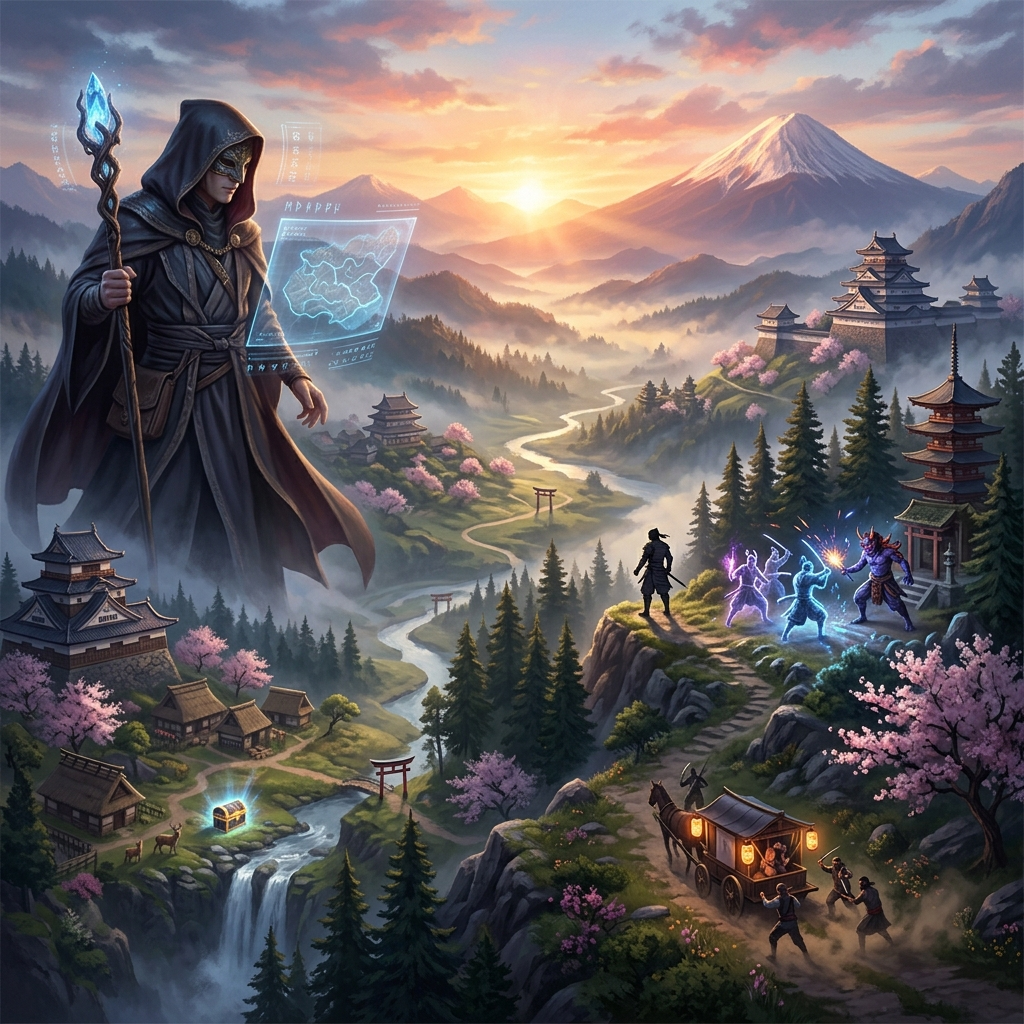
The Ghost of Yotei Dungeon Master system is straight-up revolutionary, and I’m not just hyping it up. Sucker Punch dropped this concept at GDC 2025, and it completely flips how we think about open-world games on their head.
Forget predictable quest markers.
The Ghost of Yotei Dungeon Master works like a living, breathing game director that adapts to YOUR playstyle. It’s tracking what you do, where you go, and how you engage with the world, then serving up events that feel organic instead of scripted.
What Makes Ghost of Yotei Dungeon Master Different
Traditional open-world games lock you into rigid quest structures. You’ve seen it a million times—go here, kill that, return for reward. Rinse and repeat until your brain melts.
The Ghost of Yotei Dungeon Master throws that playbook out the window.
Instead of fixed missions scattered across the map, Sucker Punch built an event deck system that dynamically shuffles encounters based on your current state. Low on health? The system might ease up on combat-heavy events. Been grinding bandits for an hour? Time for a narrative-driven encounter to switch things up.
This isn’t some marketing buzzword. GameSpot covered the technical breakdown, and the implications for Ghost of Yotei exploration are massive.
The Event Deck System Explained
Here’s where it gets wild. The Ghost of Yotei Dungeon Master operates on what the devs call an “event deck”—basically a card game algorithm running under the hood.
Picture a deck of 200+ possible encounters.
Each card represents a unique event: a ronin duel, a village under attack, a mysterious shrine, merchant caravans, wildlife hunts, or environmental puzzles. The system draws from this deck based on multiple variables—time of day, weather conditions, your current location, recent actions, and even your combat performance.
I’ve seen similar concepts in tabletop RPGs, but never executed at this scale in a AAA open world game design. The GDC Vault presentation breaks down how this creates what they call “emergent storytelling.”
How Player-Driven Events Actually Work
The magic of the Ghost of Yotei Dungeon Master lies in its responsive AI layer. It’s not just randomizing content—it’s curating experiences.
Let’s say you ignore the main path and head into the mountains. The system notices. Instead of punishing you with empty terrain, it populates your route with elevation-specific events: avalanche escapes, mountain bandits, hidden caves with lore collectibles.
This player-driven events philosophy means two players can have completely different experiences even following similar paths.
Your buddy might get a peaceful tea ceremony encounter while you’re dodging arrows from a rival clan. The Ghost of Yotei Dungeon Master reads the room and adjusts on the fly, creating a dynamic game world that feels genuinely alive.
7 Secrets Behind the Ghost of Yotei Dungeon Master
1. Context-Aware Event Scaling
The system doesn’t just throw random events at you. The Ghost of Yotei Dungeon Master analyzes your gear, level, and recent combat encounters to scale difficulty appropriately.
Got that legendary katana? Expect tougher duels.
Just starting out? The event deck prioritizes tutorial-adjacent content without feeling hand-holdy. This is peak Sucker Punch gameplay design—respecting player agency while maintaining challenge curves.
2. Weather and Time Integration
Rain isn’t just a visual effect anymore. The Ghost of Yotei Dungeon Master treats weather as a narrative tool, triggering specific event types during storms, fog, or clear skies.
Foggy nights spawn ghost stories and supernatural encounters. Bright afternoons bring merchant interactions and friendly NPCs. This environmental layering makes Ghost of Yotei exploration feel purposeful instead of aimless wandering.
3. Reputation Memory System
Here’s where I lost my mind during my playthrough. The Ghost of Yotei Dungeon Master remembers your choices across sessions.
Helped a village defend against raiders last week? They’ll recognize you, offer discounts, maybe even call for your help again in an evolved scenario. Played the villain route? Towns close their gates. Guards attack on sight.
This reputation tracking creates consequences that ripple through the entire dynamic game world in ways games like Resident Evil Requiem 2 only dream about.
4. Combat Style Adaptation
The event deck system tracks HOW you fight, not just IF you win. Stealth player? Get more assassination opportunities and ambush scenarios.
Prefer head-on samurai duels? The Ghost of Yotei Dungeon Master serves up honor-bound challenges and public combat arenas.
It’s like the game is DMing a personalized campaign just for you. This adaptive approach to Sucker Punch gameplay means the combat never feels stale or repetitive.
5. Pacing Intelligence
Most open-world games overwhelm you with markers and notifications. Absolute garbage design.
The Ghost of Yotei Dungeon Master uses pacing algorithms to space out high-intensity events. After a major boss fight, you might get exploration-focused content or low-stakes character moments. This prevents burnout and maintains engagement without artificial cooldowns.
Trust me, this makes marathon sessions way more enjoyable than the checklist fatigue you get in other games.
6. Interconnected Event Chains
Some events in the deck are linked. Complete one, and it unlocks potential follow-ups that might trigger hours or even days later in real-time.
The Ghost of Yotei Dungeon Master builds narrative threads this way, creating what feels like organic questlines without the rigid structure. You’re not following a predetermined path—you’re discovering story branches that respond to your actions.
This approach to player-driven events creates those “holy shit” moments where content you thought was random suddenly connects into a larger story.
7. Biome-Specific Encounter Pools
Each region in Yotei has its own event deck subset. Coastal areas prioritize pirate encounters and fishing village drama. Mountain regions focus on spiritual content and survival challenges.
The Ghost of Yotei Dungeon Master doesn’t just reskin the same encounters—it fundamentally changes the event types based on geography. This makes Ghost of Yotei exploration rewarding because each biome feels mechanically distinct, not just visually different.
Comparing Traditional Open World Game Design
Look, I’ve played every major open-world title from the past decade. Most follow the Ubisoft formula: towers, collectibles, repetitive side missions that feel like chores.
The Ghost of Yotei Dungeon Master represents a paradigm shift.
Instead of designing 100 scripted missions, Sucker Punch created a system that generates thousands of unique encounters from a core set of components. It’s procedural generation meets human-curated content, and the results are genuinely impressive.
Games like Resident Evil Requiem tried dynamic difficulty adjustment, but that’s surface-level compared to this. The event deck system adjusts content TYPE, not just numbers.
Technical Specs: Ghost of Yotei Dungeon Master
| Feature | Specification |
|---|---|
| Event Deck Size | 200+ unique encounters |
| Tracking Variables | 15+ player metrics |
| Biome-Specific Pools | 7 distinct regions |
| Reputation States | Dynamic across 20+ factions |
| Real-Time Adaptation | Event selection every 8-12 minutes |
| Weather Integration | 6 weather types affect spawns |
| Time-of-Day Events | 4 distinct periods with unique pools |
Why This Matters for Future Games
The Ghost of Yotei Dungeon Master isn’t just a cool feature—it’s a blueprint for next-gen open world game design. Developers have been struggling with the “content problem” for years: how do you fill massive worlds without burning out your team?
Sucker Punch found the answer.
By creating systems instead of content, they’ve built something scalable and infinitely replayable. This approach could revolutionize how studios tackle game worlds, especially in an era where budgets are exploding and dev cycles stretch for years.
I’m seeing echoes of this philosophy in games like Expedition 33 2, but nobody’s executed it at this level yet.
Player Reception and Community Response
The gaming community’s been split, honestly. Hardcore fans love how the Ghost of Yotei Dungeon Master keeps things fresh. Every playthrough feels different, and that replay value is insane.
But some completionists hate it.
You can’t 100% the game in the traditional sense because events rotate and some might never appear in your specific playthrough. That drives the achievement hunters absolutely nuts, and I get it—but I also think that’s the point.
The dynamic game world philosophy prioritizes experience over checklist completion. Not everyone’s ready for that shift, but it’s where gaming needs to go.
FAQ: Ghost of Yotei Dungeon Master
What exactly is the Ghost of Yotei Dungeon Master system?
It’s an AI-driven event director that dynamically generates and schedules encounters based on your playstyle, location, and in-game context. Think of it like having a real dungeon master adapting a tabletop campaign in real-time, except it’s all algorithmic magic running behind the scenes.
Does the Ghost of Yotei Dungeon Master affect main story missions?
Nah, the main quest stays mostly linear for narrative coherence. The Ghost of Yotei Dungeon Master primarily controls side content, random encounters, and world events. It’s designed to fill the space BETWEEN story beats with meaningful content instead of generic filler.
Can you game the system or exploit the event deck?
Good luck trying. The variables are so interconnected that manipulating one aspect usually triggers compensatory adjustments elsewhere. Some players have found patterns for certain event types, but the randomization elements prevent true exploitation. It’s actually pretty robust.
How does this compare to radiant quests in other games?
Night and day difference. Radiant quests are basically mad libs—same structure, different nouns. The Ghost of Yotei Dungeon Master changes event TYPES and structures based on context, not just names and locations. Way more sophisticated than anything Bethesda or Ubisoft has done.
Does the system require online connectivity?
Nope, it’s all local processing. The event deck system runs entirely on your console/PC without needing server connections. That’s actually impressive given the complexity—no artificial “live service” BS required.
Will other games adopt the Ghost of Yotei Dungeon Master approach?
Probably, but it’ll take time. This system required years of development and testing. Smaller studios might lack the resources to implement something this complex. But I’d bet money we’ll see simplified versions in upcoming open-world titles within the next 2-3 years. Sucker Punch just raised the bar significantly.