
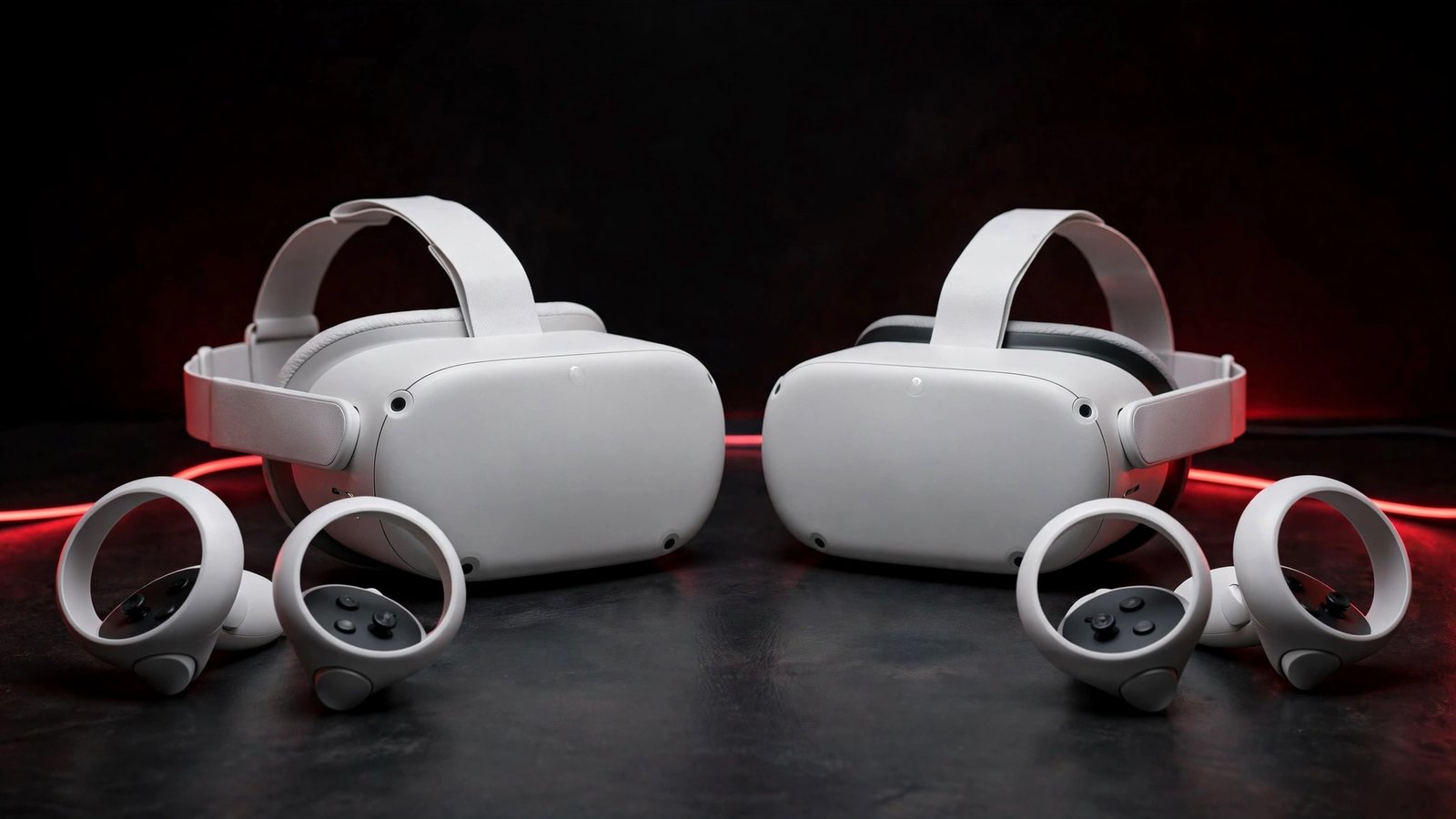
Looking for the best VR headset in 2026? If you want the best VR headset you can buy in 2026, get the Meta Quest 3 512GB — it’s the sharpest, most complete standalone headset Meta makes, and nothing else in its class matches its lenses and mixed reality. But if you’re buying your first headset, or you just want the best value in VR right now, the Meta Quest 3S 128GB is the smarter buy for most people: it plays the exact same games on the exact same chip, and the money you save buys a lot of games.
That’s the whole story in two paragraphs, and the rest of this guide is the evidence behind it. Every headset below runs on its own — no gaming PC, no console, no wall of sensors — and every one of them opens up the same Quest library. What changes between them is how clearly you see that library, how much of it you can keep installed at once, and how much room your wallet has left afterwards.
Browse the full category: VR. Compare the official specs on Meta’s headset compare page.
Key facts
- All three headsets run standalone — no PC, console, or external sensors required — and all three share the full Quest game and app library.
- The Quest 3 and Quest 3S run the same Snapdragon XR2 Gen 2 chip with 8GB of RAM, so games perform the same on either line.
- The Quest 3’s pancake lenses and 2,064 × 2,208 per-eye display beat the 3S’s Fresnel lenses and 1,832 × 1,920 per-eye display for edge-to-edge sharpness.
- The Quest 3S 128GB and 256GB are the same headset in every respect except storage — display, lenses, chip, and controllers are identical.
- Meta announced no new Quest headset at Meta Connect on September 23, 2026, so the Quest 3 and 3S remain its current standalone line.
Which VR headset should you buy in 2026?
Buy the Quest 3 512GB if you want the best VR headset and you’ll play often enough to notice the difference; buy the Quest 3S 128GB if you’re new to VR or you want the best value; pick the Quest 3S 256GB only if you know you’ll keep a big library installed. The three headsets below cover that entire decision — there’s no fourth option in Meta’s current standalone line worth your attention, and no new Quest is coming to change the picture this year.
What’s the difference between the Quest 3 and the Quest 3S?
The difference is the optics, not the performance. Both headsets run Qualcomm’s Snapdragon XR2 Gen 2 chip with 8GB of RAM, so a game launches and plays identically on either one — the 3S is not a slower Quest 3, and no developer has to water anything down for it. Where the Quest 3 pulls ahead is what you actually look through: pancake lenses that stay sharp right to the edges of the image, a higher-resolution display (2,064 × 2,208 pixels per eye against the 3S’s 1,832 × 1,920), and a wider field of view of around 110 degrees against the 3S’s 96. PCMag’s reviewers, quoted in recent comparisons, describe the 3S image as occasionally grainy next to sharper headsets, and that matches the lens story — Fresnel lenses have a smaller sweet spot, so text and menus near the edges of the view can go soft unless you turn your head to face them.
Mixed reality splits them too. The Quest 3 carries a depth sensor alongside its color passthrough cameras, so the real world looks crisper through it and room mapping lands more precisely; the 3S uses the same color cameras but works out depth in software, which is fine for seeing your room and dodging the coffee table, but a visible step down if mixed-reality apps are your main reason for buying. Lens spacing is the quieter gap: the Quest 3 adjusts continuously from 53 to 75mm, while the 3S clicks between three presets (58, 63, and 68mm), so unusual eye spacing fits the Quest 3 better. One twist favors the cheaper headset — the 3S’s lower-resolution display sips less power, so Meta rates it at up to 2.5 hours of average use against the Quest 3’s 2.2, a gap Tom’s Guide testing put at roughly 20–25 minutes of real gameplay.
Is the Quest 3S 128GB really the same headset as the 256GB?
Yes — plainly, and this is the one fact in this guide worth stating twice. The 128GB and 256GB Quest 3S models share the same display, the same Fresnel lenses, the same chip, the same memory, and the same Touch Plus controllers; Android Central’s hands-on put it bluntly, saying buyers of the larger model are “just paying more for extra storage,” and Meta’s own compare page backs that up by listing identical specs apart from capacity. Your only decision here is library size: neither headset takes a memory card, so the storage you buy is the storage you keep, though cloud saves mean you can always uninstall a finished game and download it again later without losing progress. If you play a handful of games at a time and you’re happy rotating them, 128GB is genuinely workable; if you hoard big titles or keep a lot of recorded video on the headset, the 256GB model buys peace of mind.
Meta Quest 3S 128GB — best for: first-time VR buyers and best value
Strengths: It’s the cheapest route into current-generation standalone VR, and it doesn’t feel like a compromise where it counts — same chip, same controllers, same library as the Quest 3, in a headset that needs nothing beyond the box and a phone app for setup. Battery life is the best of the three, a glasses spacer comes in the box, and because it runs everything on its own, there’s no hidden second purchase lurking behind it: no PC, no sensors, no cables.
Weaknesses: Fresnel lenses blur toward the edges, so menus and subtitles off-center need a head turn to read clearly; the three-step lens spacing won’t suit every face; there’s no 3.5mm headphone jack, so private listening means wireless audio; and 128GB fills up fast once you install several large games.
Verdict: The best value in VR, and the headset we’d hand to a friend who has never tried VR. It clears the bar that matters — the full modern Quest experience — and leaves the rest of your budget for games.
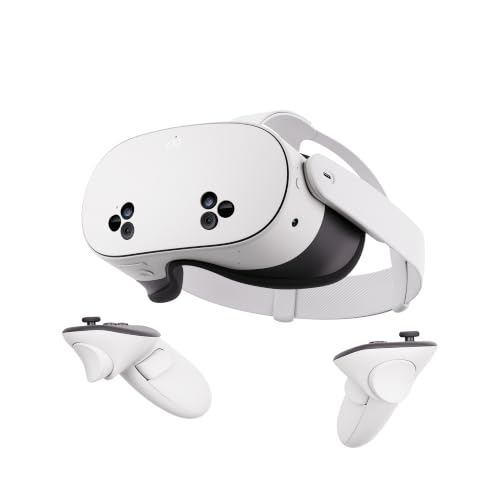
- NO WIRES, MORE FUN — Break free from cords. Game, play and explore immersive worlds — untethered and without limits.
- 2X GRAPHICAL PROCESSING POWER — Enjoy lightning-fast load times and next-gen graphics for smooth gaming powered by the S…
- EXPERIENCE VIRTUAL REALITY — Take gaming to a new level and blend virtual objects with your physical space to experience…
Meta Quest 3S 256GB — best for: regular players who keep a bigger library
Strengths: Everything that makes the 128GB model good, with twice the room — a bigger rotating library of installed games, space for recorded clips and media, and no uninstall shuffle when a new big release lands. For a household sharing one headset, or a player who jumps between a dozen titles, that breathing room is real.
Weaknesses: It inherits every optical limitation of the 128GB model — same Fresnel lenses, same resolution, same three-step lens spacing — and it narrows the gap to the Quest 3 without closing the quality gap. That’s the honest catch: the closer its street price creeps to the Quest 3’s, the harder the 3S’s lenses are to defend.
Verdict: Buy it if you know your library habits demand the space; if you’re choosing between this and the Quest 3 and the difference is small, step up to the Quest 3 instead. Storage is the only thing this model adds, so judge it purely on that.
- NO WIRES, MORE FUN — Break free from cords. Game, play and explore immersive worlds — untethered and without limits.
- 2X GRAPHICAL PROCESSING POWER — Enjoy lightning-fast load times and next-gen graphics for smooth gaming powered by the S…
- EXPERIENCE VIRTUAL REALITY — Take gaming to a new level and blend virtual objects with your physical space to experience…
Meta Quest 3 512GB — best for: enthusiasts, and the overall winner
Strengths: This is the best VR headset of the three by a clear margin, and the overall winner of this guide. Pancake lenses keep the image sharp edge to edge, the higher-resolution display makes text and distant detail genuinely crisper, the wider field of view feels more open, and the depth sensor makes mixed reality noticeably better — crisper passthrough, more precise room mapping. Continuous lens adjustment fits more faces, it keeps a 3.5mm jack, and 512GB means dozens of major titles installed at once with no uninstall juggling. It also doubles as a PC VR headset over a link or wireless streaming if you ever get a gaming PC later.
Weaknesses: Battery life is the shortest of the three at around 2.2 hours of average use, so long sessions need a break or a strap with a battery; and it’s the premium-priced model of the line, which only makes sense if you’ll actually use the better optics often enough to notice them.
Verdict: The best VR headset here, full stop — and the one to buy if VR is a hobby rather than a curiosity. Everyone else should start with the 3S 128GB and upgrade later, when they know VR has stuck.
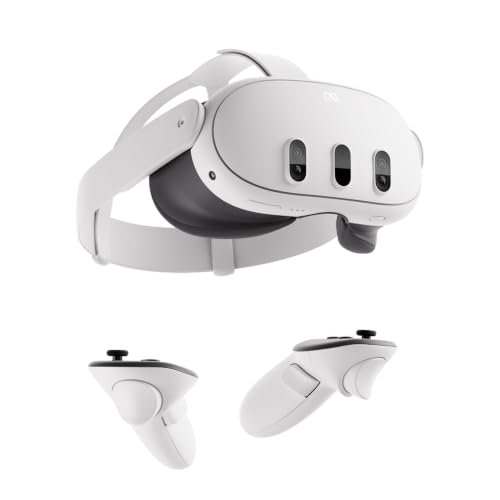
- NEARLY 30% LEAP IN RESOLUTION — Experience every thrill in breathtaking detail with sharp graphics and stunning 4K+ Infi…
- NO WIRES, MORE FUN — Break free from cords. Game, play and explore in immersive worlds — untethered and without limits.
- 2X GRAPHICAL PROCESSING POWER — Enjoy lightning-fast load times and next-gen graphics for smooth gaming powered by the S…
Best VR headset 2026 — comparison
| Quest 3S 128GB | Quest 3S 256GB | Quest 3 512GB | |
|---|---|---|---|
| Best for | First headset, best value | Bigger game library | Best overall experience |
| Chip / RAM | Snapdragon XR2 Gen 2 / 8GB | Same | Same |
| Lenses | Fresnel | Fresnel | Pancake |
| Resolution per eye | 1,832 × 1,920 | 1,832 × 1,920 | 2,064 × 2,208 |
| Field of view | ~96° horizontal | ~96° horizontal | ~110° horizontal |
| Lens spacing | 3 steps (58/63/68mm) | 3 steps (58/63/68mm) | Continuous (53–75mm) |
| Depth sensor | No (software depth) | No (software depth) | Yes |
| Battery (rated) | Up to ~2.5 hours | Up to ~2.5 hours | Up to ~2.2 hours |
| Weight | ~514g | ~514g | ~515g |
| Headphone jack | No | No | Yes |
| Storage expansion | None | None | None |
| Controllers | Touch Plus | Touch Plus | Touch Plus |
Do you need a PC to use these headsets?
No — and that’s the point of this whole category. Each of these three headsets runs games and apps entirely on its own hardware, with no PC, console, or external sensors involved, and setup runs through the free Meta Horizon phone app. A gaming PC only enters the picture as an optional extra: the Quest 3 in particular can stream PC VR titles wirelessly or over a link cable if you already own a capable rig, but nobody should buy a PC just to use one of these headsets.
How long does the battery last, and is that a dealbreaker?
Expect roughly two to two-and-a-half hours of play per charge — the 3S a little longer than the Quest 3 — and no, it’s not a dealbreaker, but it does shape how you play. Short, punchy sessions (fitness apps, rhythm games, a couple of rounds of anything competitive) fit comfortably inside a charge; marathon story sessions don’t, and that’s true of every standalone headset in this class, not just these three. A battery head strap is the standard fix if long sessions matter to you, and it’s worth budgeting for if you already know you play for hours at a stretch.
Should you wait for the Quest 4?
No. Meta announced no new Quest headset at its Connect event on September 23, 2026, and current coverage puts a successor in 2027 or later — which means the Quest 3 and 3S are the current line for the foreseeable future, not a stopgap you’d regret buying. If you want VR now, buy now; the only thing waiting buys you is months without a headset.
Final verdict
One winner, three honest slots. The Meta Quest 3 512GB is the overall winner — the best lenses, the best mixed reality, and the most storage in Meta’s current line. The Meta Quest 3S 128GB is the best buy for most people: the full Quest experience at the entry tier, and the headset we’d recommend to any first-time buyer. The Meta Quest 3S 256GB is the specialist pick — identical to its smaller sibling in everything but storage, so it earns its place only for players who genuinely keep a big library installed. Everything else in the VR aisle is a secondary option on the category page, not a rival to these three.
As an Amazon Associate, EWM PLAY earns from qualifying purchases made through links on this page, at no additional cost to you.